
My roommate oftentimes finds me with my computer perched on my lap surrounded by notebooks  and textbooks alike, eyes glued on the Futurama Netflix binge I put on as “background noise” for studying. It is by far one of my favorite shows with episodes I can watch over and over again. Moreover, the writers have done a particularly good job in incorporating real science into many of the episodes. David X. Cohen, the head writer, and one of the creators and executive producers of the show, is actually the son of two biologists with a B.A. in physics from Harvard and a M.Sc. in computer science from UC Berkley.
I intend to applaud many of the scientifically themed episodes as great examples of ways to explain science to the general public. Unfortunately, and by virtue only of what came on tonight’s binge, I will be starting off with a critique.  In Obsoletely Fabulous (Season 5, episode 14) Bender (a robot) becomes jealous of the new Robot 1X and agitated when his friends tell him to go get an upgrade. In a act of rebellion Bender escapes and finds himself on a deserted island. Devoid of the liquor that sustains him, Bender is left on the brink of life, narrowly rescued by the other inhabitants of the island, outdated robots who had also refused an upgrade. Embracing the anti-technology ideology of these robots Bender makes the choice to strip himself of his metal exterior and replace it with a wooden frame. That’s enough context for the post. You can read more on the episode here, or on the series here.
I’m not bothered by the fact that Bender keeps his metal eyes and mouth, or the advanced technology in his internal circuits that keep him running. The problem is that this perpetuates ideas about technology and advanced thought as being equated to complexity and certain materials.
 As a paleoanthropologist I am constantly battling the image of a cave man walking around with a big club, spear, or proto stone wheel. There are assumptions that these more primitive tools are not quite yet “technology”. For many reasons this image is terribly wrong.

1. Spears and the wheel are quite advanced technology.
The oldest tools we have in the archaeological record are of the Oldowan industry. Oldowan tools are simple core-and-flake tools. Early hominins would hit two rocks together. The rock in their dominant hand would be round and strong called the hammerstone. The hammerstone would hit against the core with the object of knocking off a flake. These early Oldowan flakes would be of variable sizes, and were probably used only a few times to cut before dulling out, breaking, or otherwise being abandoned.
The earliest evidence for Oldowan stone tools is 2.6 million years ago in Gona, Ethiopia. However, cutmarks on animal bones from as early as 3.4 million years ago from Dikika, Ethiopia indicate that much earlier hominins were at least using sharp stones as tools, if not making tools themselves.
This brings up a little talked about point. Before hominins started making stone tools in a typical way and at high enough frequencies that they would be found in the archaeological record millions of years later, they were probably using other technologies. This may include the use of organic materials such as sticks and animal bones that would not stand the test of time. Today it is well documented that chimpanzees use sticks to fish out termites from mounds, and even stones to crack nuts. New observations published last year show that Gorillas may also use tools for food acquisition. It is not far fetched to believe that earlier hominins were using technology for millions of years before spears and the wheel.
The earliest evidence of spears for throwing is less than 100 thousand years ago (probably around 90-70 kya), made by modern humans (Homo sapiens). The wheel does not even come about until less than 5,000 years ago in Europe and the Middle East.

2. The earliest tool users and makers were not cavemen.
First off the idea of a caveman is not accurate. However, based on the historical origins of the term, caveman in the vernacular relates to Neanderthals. If caveman and Neanderthal are to be more or less equated then the drawings need to be revised. Neanderthals made incredibly complex Mousterian tools, controlled fire, made clothes, were skilled hunters, occasionally made symbolic objects for ornamentation, and even buried their dead with grave goods including flowers.
Alternatively, the earliest tool maker that we have evidence for would probably have been Australopithecus afarensis, the species of the famous skeleton “Lucy”. There is no evidence that A. afarensis controlled fire, hunted actively, made any clothing or ornamental objects, or had other complex components of culture. Most importantly, A. afarensis did not live or sleep in caves. Instead, components of the fossilized skeletons show the species probably continued to climb trees, and some have hypothesized they slept in the trees to avoid predators at night.
3. Technology does not equal metal or electronics
Humans have been manipulating the resources available to them in their environment for millions  of years. This is all advanced technology. Humans, and our early ancestors are virtually unique in our ability to make and use tools. While chimpanzees and gorillas do seem to engage in tool use, just like capuchin monkeys of South America and some birds, particularly crows, humans take tool use to a whole new level. It is easy to look at a simple rock or wheel or walkman and think of those are primitive and not technological.
Unfortunately, this way of thinking does more than harm the image of Neanderthals and other earlier hominins. Devaluing the technological advances and necessary cognitive abilities behind early tools contributes to institutionalized hierarchies of “more primitive” societies as lacking technological advances.
4. Even “primitive” technologies are complex and hard to make
I think many westerners would have more appreciation for the technologies of our ancestors if they had a try at making some of these older tool industries. As a student on the Koobi Fora Field School over the summer of 2011 I was tasked with making “primitive” tools. This was no easy feat.
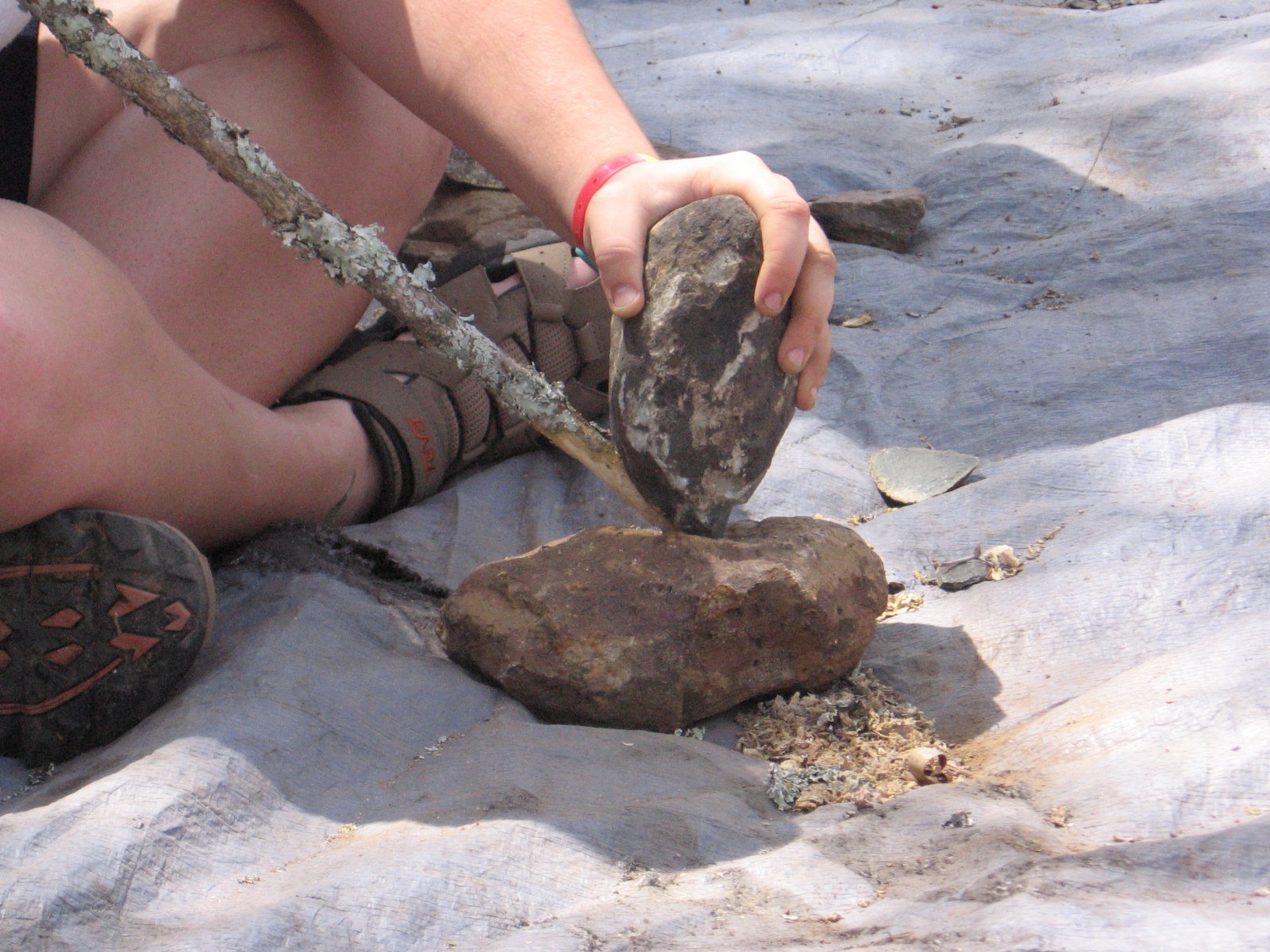
First we were asked to use stone tools made by the more skilled faculty to shape sticks for digging out roots and tubers. It is believed that some species of hominins relied on digging up these so called underground storage organs (USOs) for food and to consume their water content. The Hadza and other traditional hunter-gatherer populations have also been observed to collect USOs.

Our next task was to make the stone tools ourselves. Renowned archaeologists and stone knappers instructed us on the proper techniques for choosing the right cores, hammerstones, and platforms to strike one onto the other. While I did manage a few prime flakes, the biggest lesson was an appreciation for mental and physical faculties needed for the creation of even the most simple forms of technology.
 Kristen Ramirez