Find the evidence here!
As I was going through the internet procrastinating my Evolutionary Theory homework I came across some of the most damning evidence against evolution I have ever seen. I immediately stopped studying for a now definitely worthless topic to share this news with you all. Buzzfeed, as it so often does, provided me with a thought provoking and entertaining series of examples as to why evolution cannot possibly be real. Ken Ham of the creationist museum should take some of these pristine examples of evolution’s failure the next time he faces a scientist in a debate about evolution (this is a reference to the Bill Nye the vs. Ken Ham of the Creationist Museum debate [full video] [NPR write up]).
But on a serious note, musings like these have unfortunately perpetuated a false concept of evolution. In fact, these “18 Reasons Why Evolution Is Totally And Completely Fake” not only illuminate that we are here due to the process of evolution but also provide more damning evidence against creationist claims. My argument is as follows:

1) Evolution needs preexisting natural variation to work. The first Buzzfeed reason shows us the natural variation in human behavior. One girl decided it was a good idea to put herself into a box to go down a flight of stairs – but her three friends did not. Moving forward, I can only guess which one is more at risk for not making it long enough to reproduce. And this is how natural selection at its core works. In a population with some natural variation, some individuals will be better suited than others (“survival of the fittest”). When the “unfit” ones go about doing “unfit” things, like shoving themselves into boxes to be pushed down a staircase, they are reducing their ability to pass on their “unfit” genes to the next generation. At the same time, more “fit” individuals, like those who decided to just hold the camera for this ordeal, are more likely to live another day and reproduce. The next generation will have more people that are the descendants of “fittest”, and over time the genes that made “unfit” people as such will represent less and less of the population until those “unfit” genes are all gone.
Now you might be asking why then each species is not perfectly adapted? Unfortunately, while natural selection is trying to keep the “fit” and get rid of the “unfit” genes, the environment is constantly changing so that what was once “fit” or “unfit” might be different 5 generations later. Furthermore, mutations are constantly popping up. These are usually bad and really ruin natural selection’s day. Like when your mom mopped the whole house and then you let your muddy dog in. Only sometimes does a new mutation turn out to be more “fit,” and then natural selection has to work to build up that one mutation in the whole population.
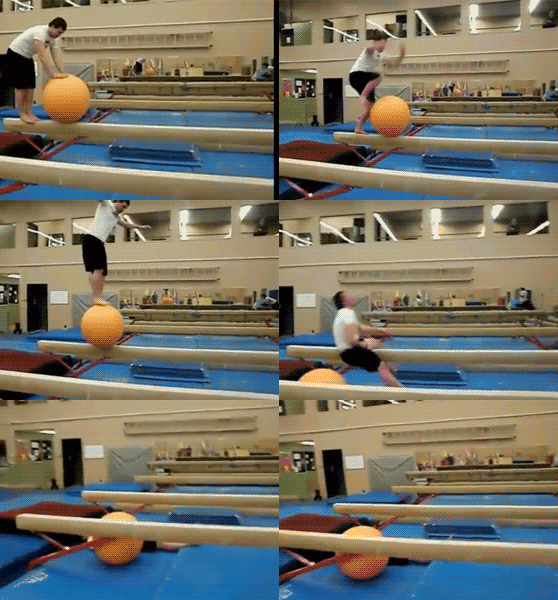
2) Evolution is not goal oriented, and it takes a lot of time. As described in point 1, natural selection has to work on a generation by generation level, and can only act on preexisting variation. But more than just working with the variation, it is really selecting on how the different variants of a trait interact with the environment at that particular time to be “fit” or “unfit.” Take reason #17 for example. For the last 7 million years our human lineage has been adapting to living on the ground and walking on two legs (terrestrial bipedalism). Over all of these hundreds of thousands of generations natural selection has been keeping those individuals best suited for walking around on a flat and stable surface. Any ancestor in the past who wasn’t so good at walking on the ground but who may have been great at balancing on a ball were unfortunately “unfit” for their environment. Evolution could not predict that it should keep those individuals, and their genes, around because one day millions of years into the future this guy was going to need the ability to stand on a ball on a balance beam.
3) Because we came from an ancestor that was not a modern human, we have some abilities and instincts that stick with us. These primitive retentions may not be great for us now but may have been very important to our ancestors. Unfortunately, natural selection has not been able to eliminate some of these disadvantageous tendencies yet.
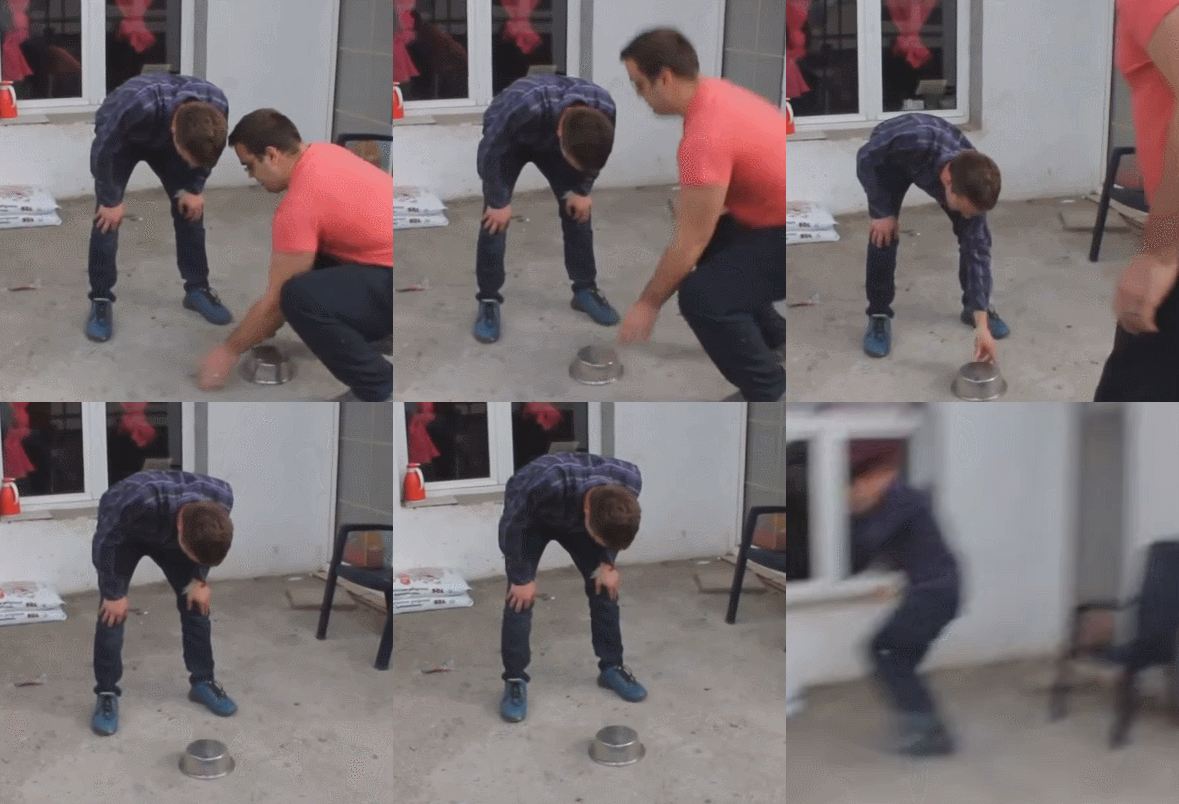
For example Buzzfeed reason #11. Primates are highly visual animals. The last 65 million years of primate evolution, of which we are one of the living products, have selected for using our eyes, instead of our ears or noses, to learn about our environment. That’s why humans, apes, monkeys, and prosimians (tarsiers, lemurs, lorises, and galagos) all have forward facing eyes. Your dog or the squirrel that hangs out in your backyard, or most other mammals really, have eyes oriented on the sides of their heads. We have also evolved relatively larger brains compared to other mammals and are very curious. This poor guy in #11 was just following his 65 million year old primate honed instincts to investigate what his friend had done by taking a good and close look.

The same problem of instinct driven danger is the case for Buzzfeed reason #16. Most primates are arboreal, or live in the trees. This was still the case in our last common ancestor with chimpanzees that lived about 7 million years ago. In fact, even after our ancestors, hominins, started to walk on two legs on the ground it still seems like for a few million years more they also climbed up into the trees for some portion of the day. Whether that was just to sleep up and away from lions, to grab fruit and nuts to eat, or to scope out what was over there yonder, the instinct and ability to climb seems to have been very important in our own ancestors until very recently. While modern humans typically don’t climb into trees as often as our ancestors did, those instincts run strong. As a little kid I know I was always trying to climb around, from the trees in the park to the roof of the doghouse in my backyard. We still have our instincts for this behavior but have unfortunately had to trade our physical ability to do this well to be better built to walk on the ground. This mismatch between instinct and body form left reason #16 flat on her face.

4) Humans have evolved some new behaviors that may have been really harmful for our ancestors to have. For example, many of our early ancestors were most definitely afraid of snakes [read more about that here]. It is evident by Buzzfeed reason #5 that that model has evolved away from our primal, ancestral fear of snakes and entered into a new way of being. Now was that the best evolutionary course to take? Apparently not…
5) To rephrase the buzzfeed lead: If creationism happened, then why were these dingalings made to muck everything up?

 Kristen Ramirez